
Spring Boot is an open-source, microservice-ready Java framework built on top of the traditional Spring Framework. It provides an opinionated, convention-over-configuration approach to building stand-alone, production-grade applications. Instead of requiring developers to manually configure dispatchers, view resolvers, database connectors, and XML descriptors, Spring Boot makes sensible assumptions based on classpath dependencies and provides ready-to-run configurations right out of the box.
Why is Spring Boot Used ?
Traditional Spring applications suffered from what developers often called “configuration hell” — massive XML schemas, verbose @Configuration classes, complex servlet lifecycle wiring, and mismatched dependency versions. Spring Boot solves these bottlenecks by:
-
Eliminating XML and Boilerplate Setup: You write code for business logic rather than wiring basic framework primitives.
-
Speeding Up Time-to-Market (RAD): Projects can be spun up in seconds using Spring Initializr with all sensible defaults pre-applied.
-
Creating Standalone Executables: Packaging an application into a single self-contained “Fat/Uber JAR” containing both the runtime dependencies and an embedded web server.
-
Simplifying Cloud & Microservices Architectures: Lightweight runtime characteristics, flexible 12-factor configuration support, and cloud-native integrations make it the de facto backend framework for containerized microservices.
How Spring Boot Simplifies Spring Development ?
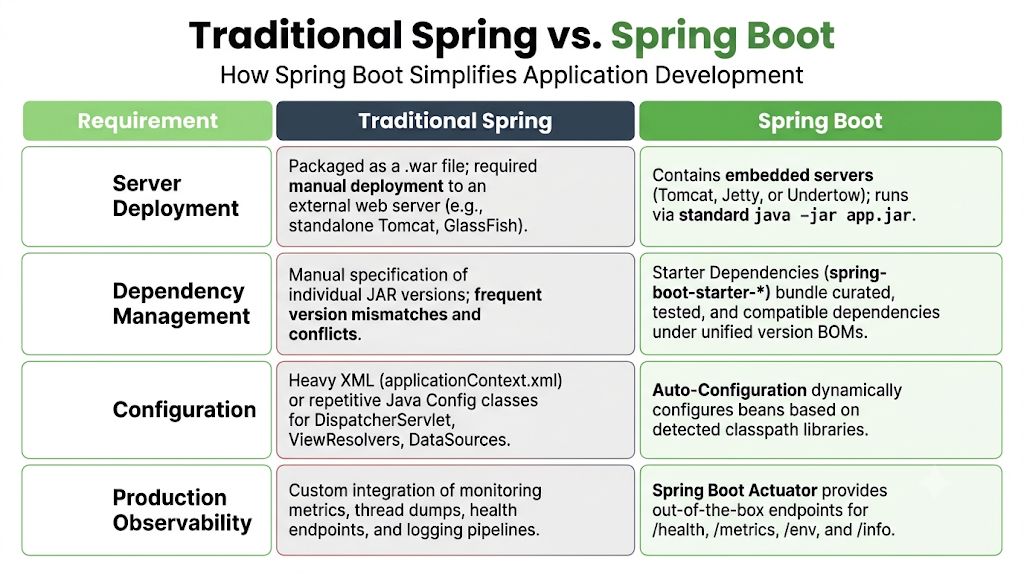
The contrast between traditional Spring and Spring Boot illustrates where the simplification happens:
Core Features of Spring Boot
1. Auto-Configuration (@EnableAutoConfiguration)
Spring Boot inspects the classpath, existing beans, and configured properties to automatically wire beans.
-
If
spring-boot-starter-weband Tomcat are on the classpath, it automatically provisions aDispatcherServletand embedded servlet container. -
If
mysql-connector-jis present and JDBC credentials exist in properties, it automatically binds aHikariDataSourceconnection pool. -
It follows a “convention over configuration” design: automatically configured beans back off when you define your own custom
@Bean.
2. Starter POMs / Dependencies
Curated sets of dependency descriptors that bring in everything required for specific capabilities:
-
spring-boot-starter-web: Spring MVC, REST support, Jackson JSON serializer/deserializer, and embedded Tomcat. -
spring-boot-starter-data-jpa: Hibernate, Spring Data JPA, and connection pooling. -
spring-boot-starter-security: Spring Security authentication/authorization filters. -
spring-boot-starter-test: JUnit 5, AssertJ, Mockito, and Spring Test runner.
3. Embedded Web Servers
Eliminates external web container installations. Apache Tomcat is included by default, but it can be replaced with Jetty or Undertow simply by swapping Maven/Gradle starter dependencies.
4. Spring Boot Actuator
Provides production-ready observability endpoints without writing monitoring code:
-
Inspect health status (
/actuator/health). -
View JVM memory, GC, and thread metrics (
/actuator/metrics). -
Inspect application environment properties and active profiles (
/actuator/env).
5. Externalized & Profile-Based Configuration
Consolidates configuration into human-readable application.properties or application.yml files.
-
Supports environment variables, CLI flags, and YAML lists.
-
Built-in profile switching (
application-dev.yml,application-prod.yml) viaspring.profiles.active.