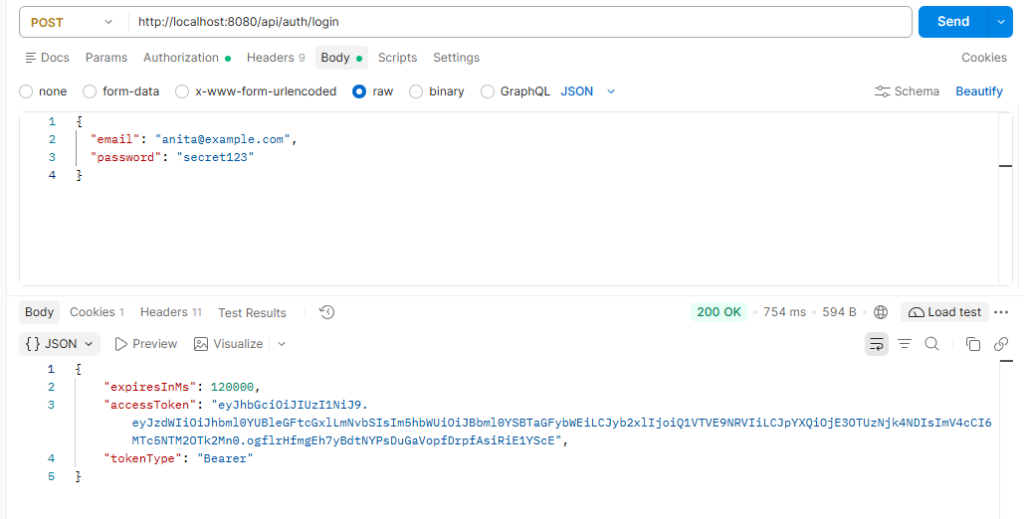
Token generation creates a signed JWT after a customer logs in successfully. The token holds the customer’s email, name, role, issue time and expiry, all signed with a secret key. Token validation checks the signature and expiry on every request, so a tampered or expired token is rejected. This lets an online store keep its APIs stateless, with no server session per customer.
Features
- Token generated at login with custom claims (
name,role) - Signed with HMAC-SHA256 using a Base64 secret key
- Configurable expiry (2 minutes here, so you can test expiry quickly)
- Validation separates valid, expired, modified (bad signature) and malformed tokens
- Public
/validateendpoint that shows the token’s claims and remaining time - Protected shopping APIs that accept only valid tokens
- BCrypt password hashing
Token Generation and Validation Steps
Generation (at login):
- Customer sends email and password.
- The password is checked against the BCrypt hash.
JwtServicebuilds the token (subject, claims,iat,exp) and signs it.- The token is returned as
Bearer.
Validation (on each request):
JwtAuthenticationFilterreads theAuthorizationheader.JwtServiceverifies the signature and expiry.- If valid, the customer is marked authenticated.
- If not, the request gets
401.
Hands-on Experiment: Building an Online Shopping Authentication API with JWT Token Generation and Validation
Aim: Generate a JWT at login and validate it on every protected request, reporting whether a token is valid, expired or tampered with.
Software/Tools Required: JDK 17, Spring Boot 3.x, Maven, MySQL 8.x, IDE, Postman
Step 1: Generate the Project via Spring Initializr
Maven, Java, Spring Boot 3.3.x, Group com.example, Artifact online-shopping-auth, Jar, Java 17. Dependencies: Spring Web, Spring Data JPA, Spring Security, Validation, MySQL Driver.
Step 2: Project structure
com.example.shoppingauth
├── entity      → Customer
├── repository  → CustomerRepository
├── service     → JwtService, JwtAuthenticationFilter,
│                 SecurityConfig, AuthService, CustomerService
└── controller  → AuthController, ShopController
Step 3: Create the files according to the project structure
package com.example.shoppingauth.entity;

import jakarta.persistence.*;

@Entity
@Table(name = "customers")
public class Customer {

    @Id
    @GeneratedValue(strategy = GenerationType.IDENTITY)
    private Long id;

    @Column(nullable = false)
    private String name;

    @Column(nullable = false, unique = true)
    private String email;

    @Column(nullable = false)
    private String password;

    @Column(nullable = false)
    private String role;

    public Long getId() { return id; }
    public void setId(Long id) { this.id = id; }

    public String getName() { return name; }
    public void setName(String name) { this.name = name; }

    public String getEmail() { return email; }
    public void setEmail(String email) { this.email = email; }

    public String getPassword() { return password; }
    public void setPassword(String password) { this.password = password; }

    public String getRole() { return role; }
    public void setRole(String role) { this.role = role; }
}
package com.example.shoppingauth.repository;

import com.example.shoppingauth.entity.Customer;
import org.springframework.data.jpa.repository.JpaRepository;

import java.util.Optional;

public interface CustomerRepository extends JpaRepository<Customer, Long> {

    Optional<Customer> findByEmail(String email);

    boolean existsByEmail(String email);
}
package com.example.shoppingauth.service;

import com.example.shoppingauth.entity.Customer;
import com.example.shoppingauth.repository.CustomerRepository;
import org.springframework.http.HttpStatus;
import org.springframework.security.crypto.password.PasswordEncoder;
import org.springframework.stereotype.Service;
import org.springframework.web.server.ResponseStatusException;

import java.util.Map;

@Service
public class AuthService {

    private final CustomerRepository customerRepository;
    private final PasswordEncoder passwordEncoder;
    private final JwtService jwtService;

    public AuthService(CustomerRepository customerRepository,
                       PasswordEncoder passwordEncoder,
                       JwtService jwtService) {
        this.customerRepository = customerRepository;
        this.passwordEncoder = passwordEncoder;
        this.jwtService = jwtService;
    }

    public Customer register(String name, String email, String password) {
        if (customerRepository.existsByEmail(email)) {
            throw new ResponseStatusException(HttpStatus.CONFLICT, "Email already registered");
        }

        Customer customer = new Customer();
        customer.setName(name);
        customer.setEmail(email);
        customer.setPassword(passwordEncoder.encode(password));
        customer.setRole("CUSTOMER");

        return customerRepository.save(customer);
    }

    public Map<String, Object> login(String email, String password) {
        Customer customer = customerRepository.findByEmail(email)
                .orElseThrow(() -> new ResponseStatusException(HttpStatus.UNAUTHORIZED, "Invalid email or password"));

        if (!passwordEncoder.matches(password, customer.getPassword())) {
            throw new ResponseStatusException(HttpStatus.UNAUTHORIZED, "Invalid email or password");
        }

        String token = jwtService.generateToken(customer.getEmail(), customer.getName(), customer.getRole());

        return Map.of(
                "tokenType", "Bearer",
                "accessToken", token,
                "expiresInMs", jwtService.getExpirationMs());
    }
}
package com.example.shoppingauth.service;

import com.example.shoppingauth.entity.Customer;
import com.example.shoppingauth.repository.CustomerRepository;
import org.springframework.http.HttpStatus;
import org.springframework.stereotype.Service;
import org.springframework.web.server.ResponseStatusException;

@Service
public class CustomerService {

    private final CustomerRepository customerRepository;

    public CustomerService(CustomerRepository customerRepository) {
        this.customerRepository = customerRepository;
    }

    public Customer getByEmail(String email) {
        return customerRepository.findByEmail(email)
                .orElseThrow(() -> new ResponseStatusException(HttpStatus.NOT_FOUND, "Customer not found"));
    }
}
package com.example.shoppingauth.service;

import com.example.shoppingauth.repository.CustomerRepository;
import jakarta.servlet.FilterChain;
import jakarta.servlet.ServletException;
import jakarta.servlet.http.HttpServletRequest;
import jakarta.servlet.http.HttpServletResponse;
import org.springframework.security.authentication.UsernamePasswordAuthenticationToken;
import org.springframework.security.core.authority.SimpleGrantedAuthority;
import org.springframework.security.core.context.SecurityContextHolder;
import org.springframework.stereotype.Component;
import org.springframework.web.filter.OncePerRequestFilter;

import java.io.IOException;
import java.util.List;

@Component
public class JwtAuthenticationFilter extends OncePerRequestFilter {

    private final JwtService jwtService;
    private final CustomerRepository customerRepository;

    public JwtAuthenticationFilter(JwtService jwtService, CustomerRepository customerRepository) {
        this.jwtService = jwtService;
        this.customerRepository = customerRepository;
    }

    @Override
    protected void doFilterInternal(HttpServletRequest request,
                                    HttpServletResponse response,
                                    FilterChain chain) throws ServletException, IOException {

        String header = request.getHeader("Authorization");

        if (header != null && header.startsWith("Bearer ")) {
            String token = header.substring(7);

            if (jwtService.isValid(token)) {
                String email = jwtService.extractEmail(token);

                customerRepository.findByEmail(email).ifPresent(customer -> {
                    UsernamePasswordAuthenticationToken authentication =
                            new UsernamePasswordAuthenticationToken(
                                    customer.getEmail(), null,
                                    List.of(new SimpleGrantedAuthority("ROLE_" + customer.getRole())));
                    SecurityContextHolder.getContext().setAuthentication(authentication);
                });
            }
        }

        chain.doFilter(request, response);
    }
}
package com.example.shoppingauth.service;

import io.jsonwebtoken.Claims;
import io.jsonwebtoken.ExpiredJwtException;
import io.jsonwebtoken.JwtException;
import io.jsonwebtoken.Jwts;
import io.jsonwebtoken.MalformedJwtException;
import io.jsonwebtoken.io.Decoders;
import io.jsonwebtoken.security.Keys;
import io.jsonwebtoken.security.SignatureException;
import org.springframework.beans.factory.annotation.Value;
import org.springframework.stereotype.Service;

import javax.crypto.SecretKey;
import java.util.Date;
import java.util.LinkedHashMap;
import java.util.Map;

@Service
public class JwtService {

    @Value("${jwt.secret}")
    private String secret;

    @Value("${jwt.expiration-ms}")
    private long expirationMs;

    private SecretKey signingKey() {
        return Keys.hmacShaKeyFor(Decoders.BASE64.decode(secret));
    }

    // ---------- TOKEN GENERATION ----------
    public String generateToken(String email, String name, String role) {
        Date now = new Date();
        return Jwts.builder()
                .subject(email)                 // who the token belongs to
                .claim("name", name)            // custom claims
                .claim("role", role)
                .issuedAt(now)                  // iat
                .expiration(new Date(now.getTime() + expirationMs))   // exp
                .signWith(signingKey())         // HS256 signature
                .compact();
    }

    // ---------- TOKEN VALIDATION ----------
    public boolean isValid(String token) {
        try {
            readClaims(token);
            return true;
        } catch (JwtException | IllegalArgumentException e) {
            return false;
        }
    }

    public String extractEmail(String token) {
        return readClaims(token).getSubject();
    }

    // Detailed validation result (used by the /validate endpoint)
    public Map<String, Object> inspect(String token) {
        Map<String, Object> result = new LinkedHashMap<>();
        try {
            Claims claims = readClaims(token);
            result.put("valid", true);
            result.put("subject", claims.getSubject());
            result.put("name", claims.get("name", String.class));
            result.put("role", claims.get("role", String.class));
            result.put("issuedAt", claims.getIssuedAt().toInstant().toString());
            result.put("expiresAt", claims.getExpiration().toInstant().toString());
            result.put("remainingSeconds",
                    (claims.getExpiration().getTime() - System.currentTimeMillis()) / 1000);
        } catch (ExpiredJwtException e) {
            result.put("valid", false);
            result.put("reason", "Token expired");
        } catch (SignatureException e) {
            result.put("valid", false);
            result.put("reason", "Invalid signature (token was modified)");
        } catch (MalformedJwtException e) {
            result.put("valid", false);
            result.put("reason", "Malformed token");
        } catch (JwtException | IllegalArgumentException e) {
            result.put("valid", false);
            result.put("reason", "Invalid token");
        }
        return result;
    }

    public long getExpirationMs() {
        return expirationMs;
    }

    private Claims readClaims(String token) {
        return Jwts.parser()
                .verifyWith(signingKey())
                .build()
                .parseSignedClaims(token)
                .getPayload();
    }
}
package com.example.shoppingauth.service;

import org.springframework.context.annotation.Bean;
import org.springframework.context.annotation.Configuration;
import org.springframework.http.HttpStatus;
import org.springframework.security.config.annotation.web.builders.HttpSecurity;
import org.springframework.security.config.http.SessionCreationPolicy;
import org.springframework.security.crypto.bcrypt.BCryptPasswordEncoder;
import org.springframework.security.crypto.password.PasswordEncoder;
import org.springframework.security.web.SecurityFilterChain;
import org.springframework.security.web.authentication.HttpStatusEntryPoint;
import org.springframework.security.web.authentication.UsernamePasswordAuthenticationFilter;

@Configuration
public class SecurityConfig {

    @Bean
    public PasswordEncoder passwordEncoder() {
        return new BCryptPasswordEncoder();
    }

    @Bean
    public SecurityFilterChain securityFilterChain(HttpSecurity http,
                                                   JwtAuthenticationFilter jwtFilter) throws Exception {
        http
            .csrf(csrf -> csrf.disable())
            .sessionManagement(s -> s.sessionCreationPolicy(SessionCreationPolicy.STATELESS))
            .authorizeHttpRequests(auth -> auth
                .requestMatchers("/api/auth/**", "/error").permitAll()
                .anyRequest().authenticated())
            .exceptionHandling(e -> e.authenticationEntryPoint(new HttpStatusEntryPoint(HttpStatus.UNAUTHORIZED)))
            .addFilterBefore(jwtFilter, UsernamePasswordAuthenticationFilter.class);

        return http.build();
    }
}
package com.example.shoppingauth.controller;

import com.example.shoppingauth.entity.Customer;
import com.example.shoppingauth.service.AuthService;
import com.example.shoppingauth.service.JwtService;
import jakarta.validation.Valid;
import jakarta.validation.constraints.Email;
import jakarta.validation.constraints.NotBlank;
import jakarta.validation.constraints.Size;
import org.springframework.http.HttpStatus;
import org.springframework.http.ResponseEntity;
import org.springframework.web.bind.annotation.*;

import java.util.Map;

@RestController
@RequestMapping("/api/auth")
public class AuthController {

    private final AuthService authService;
    private final JwtService jwtService;

    public AuthController(AuthService authService, JwtService jwtService) {
        this.authService = authService;
        this.jwtService = jwtService;
    }

    public record RegisterRequest(
            @NotBlank String name,
            @NotBlank @Email String email,
            @NotBlank @Size(min = 6, message = "Password must be at least 6 characters") String password) {
    }

    public record LoginRequest(
            @NotBlank @Email String email,
            @NotBlank String password) {
    }

    public record ValidateRequest(@NotBlank String token) {
    }

    @PostMapping("/register")
    public ResponseEntity<Map<String, Object>> register(@Valid @RequestBody RegisterRequest request) {
        Customer customer = authService.register(request.name(), request.email(), request.password());
        return ResponseEntity.status(HttpStatus.CREATED).body(Map.of(
                "message", "Registration successful",
                "customerId", customer.getId()));
    }

    // Token generation
    @PostMapping("/login")
    public Map<String, Object> login(@Valid @RequestBody LoginRequest request) {
        return authService.login(request.email(), request.password());
    }

    // Token validation
    @PostMapping("/validate")
    public Map<String, Object> validate(@Valid @RequestBody ValidateRequest request) {
        return jwtService.inspect(request.token());
    }
}
package com.example.shoppingauth.controller;

import com.example.shoppingauth.entity.Customer;
import com.example.shoppingauth.service.CustomerService;
import org.springframework.security.core.Authentication;
import org.springframework.web.bind.annotation.GetMapping;
import org.springframework.web.bind.annotation.RequestMapping;
import org.springframework.web.bind.annotation.RestController;

import java.util.List;
import java.util.Map;

@RestController
@RequestMapping("/api/shop")
public class ShopController {

    private final CustomerService customerService;

    public ShopController(CustomerService customerService) {
        this.customerService = customerService;
    }

    // Protected: needs "Authorization: Bearer <token>"
    @GetMapping("/profile")
    public Map<String, Object> profile(Authentication authentication) {
        Customer customer = customerService.getByEmail(authentication.getName());
        return Map.of(
                "name", customer.getName(),
                "email", customer.getEmail(),
                "role", customer.getRole());
    }

    // Protected: only authenticated customers can see the product list
    @GetMapping("/products")
    public List<Map<String, Object>> products() {
        return List.of(
                Map.of("id", 1, "name", "Wireless Mouse", "price", 799),
                Map.of("id", 2, "name", "Mechanical Keyboard", "price", 2499),
                Map.of("id", 3, "name", "USB-C Hub", "price", 1499));
    }
}
package com.example.shoppingauth;

import org.springframework.boot.SpringApplication;
import org.springframework.boot.autoconfigure.SpringBootApplication;

@SpringBootApplication
public class ShoppingAuthApplication {

    public static void main(String[] args) {
        SpringApplication.run(ShoppingAuthApplication.class, args);
    }
}
spring.application.name=online-shopping-auth
server.port=8080
# MySQL (database is created automatically)
spring.datasource.url=jdbc:mysql://localhost:3306/online_shopping_db?createDatabaseIfNotExist=true&useSSL=false&serverTimezone=UTC&allowPublicKeyRetrieval=true
spring.datasource.username=root
spring.datasource.password=password
spring.jpa.hibernate.ddl-auto=update
spring.jpa.show-sql=true
# JWT settings (secret is Base64, minimum 256 bits)
jwt.secret=iX9U4yv619ahYrVgl6T7KXqD5Qh+TcYzicD+ZvLJVHc=
# 2 minutes, so you can easily test token expiry
jwt.expiration-ms=120000Code language: PHP (php)Step 4: Run the ShoppingAuthApplication