An access token is a short-lived JWT the app sends with every API call to prove who the user is. A refresh token is a long-lived token kept only to get a new access token when the old one expires. When the access token expires, the app calls the refresh endpoint, and the user is never asked to log in again. A short access token limits damage if it is stolen, while the refresh token keeps the user signed in for days.
Features
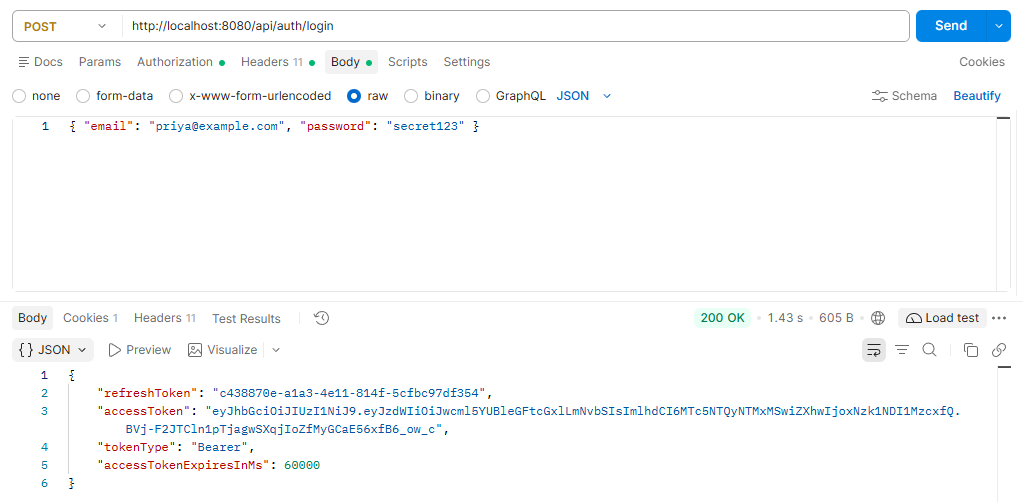
- Login returns both an access token (1 minute here) and a refresh token (7 days)
- The access token is a signed JWT validated by a custom filter on every request
- The refresh token is a random UUID stored in MySQL, so it can be revoked
- Refresh token rotation: each refresh revokes the old token and issues a new one
- Logout revokes the refresh token
- A reused or revoked refresh token is rejected with
401 - Expired access tokens get a clear
401message so the app knows to refresh
Access Token vs Refresh Token
| Access Token | Refresh Token | |
|---|---|---|
| Purpose | Call protected APIs | Get a new access token |
| Format | Signed JWT | Random UUID stored in the database |
| Lifetime | Short (1 minute in the demo) | Long (7 days) |
| Sent to | Every protected API | Only /api/auth/refresh and /logout |
| Can be revoked? | No, it simply expires | Yes, it is stored in the database |
Token Renewal Flow
- Login returns an access token and a refresh token.
- The app calls wallet APIs with the access token.
- The access token expires and the API returns
401 Access token expired. - The app sends the refresh token to
POST /api/auth/refresh. - The server checks the refresh token (exists, not revoked, not expired), revokes it, and returns a new access token and a new refresh token.
- The app retries the wallet call with the new access token.
Hands-on Experiment: Building a Digital Wallet Application with Access Token and Refresh Token
Aim: Issue access and refresh tokens at login and renew an expired access token through a refresh endpoint, with no second login.
Software/Tools Required: JDK 17, Spring Boot 3.x, Maven, MySQL 8.x, IDE, Postman
Step 1: Generate the Project via Spring Initializr
Maven, Java, Spring Boot 3.3.x, Group com.example, Artifact digital-wallet-app, Jar, Java 17. Dependencies: Spring Web, Spring Data JPA, Spring Security, Validation, MySQL Driver.
Step 2: Project structure
com.example.digitalwallet
├── entity      → User, RefreshToken
├── repository  → UserRepository, RefreshTokenRepository
├── service     → JwtService, RefreshTokenService, JwtAuthenticationFilter,
│                 SecurityConfig, AuthService, WalletService
└── controller  → AuthController, WalletController
Step 3: Create the files according to the project structure
package com.example.digitalwallet.entity;

import jakarta.persistence.*;
import java.math.BigDecimal;

@Entity
@Table(name = "wallet_users")
public class User {

    @Id
    @GeneratedValue(strategy = GenerationType.IDENTITY)
    private Long id;

    @Column(nullable = false)
    private String name;

    @Column(nullable = false, unique = true)
    private String email;

    @Column(nullable = false)
    private String password;

    @Column(nullable = false, precision = 15, scale = 2)
    private BigDecimal walletBalance;

    public Long getId() { return id; }
    public void setId(Long id) { this.id = id; }

    public String getName() { return name; }
    public void setName(String name) { this.name = name; }

    public String getEmail() { return email; }
    public void setEmail(String email) { this.email = email; }

    public String getPassword() { return password; }
    public void setPassword(String password) { this.password = password; }

    public BigDecimal getWalletBalance() { return walletBalance; }
    public void setWalletBalance(BigDecimal walletBalance) { this.walletBalance = walletBalance; }
}
package com.example.digitalwallet.entity;

import jakarta.persistence.*;
import java.time.Instant;

@Entity
@Table(name = "refresh_tokens")
public class RefreshToken {

    @Id
    @GeneratedValue(strategy = GenerationType.IDENTITY)
    private Long id;

    @Column(nullable = false, unique = true, length = 100)
    private String token;

    @ManyToOne(fetch = FetchType.EAGER)
    @JoinColumn(name = "user_id", nullable = false)
    private User user;

    @Column(nullable = false)
    private Instant expiryDate;

    @Column(nullable = false)
    private boolean revoked = false;

    public Long getId() { return id; }
    public void setId(Long id) { this.id = id; }

    public String getToken() { return token; }
    public void setToken(String token) { this.token = token; }

    public User getUser() { return user; }
    public void setUser(User user) { this.user = user; }

    public Instant getExpiryDate() { return expiryDate; }
    public void setExpiryDate(Instant expiryDate) { this.expiryDate = expiryDate; }

    public boolean isRevoked() { return revoked; }
    public void setRevoked(boolean revoked) { this.revoked = revoked; }
}
package com.example.digitalwallet.repository;

import com.example.digitalwallet.entity.RefreshToken;
import org.springframework.data.jpa.repository.JpaRepository;

import java.util.Optional;

public interface RefreshTokenRepository extends JpaRepository<RefreshToken, Long> {

    Optional<RefreshToken> findByToken(String token);
}
package com.example.digitalwallet.repository;

import com.example.digitalwallet.entity.User;
import org.springframework.data.jpa.repository.JpaRepository;

import java.util.Optional;

public interface UserRepository extends JpaRepository<User, Long> {

    Optional<User> findByEmail(String email);

    boolean existsByEmail(String email);
}
package com.example.digitalwallet.service;

import com.example.digitalwallet.entity.RefreshToken;
import com.example.digitalwallet.entity.User;
import com.example.digitalwallet.repository.UserRepository;
import org.springframework.http.HttpStatus;
import org.springframework.security.crypto.password.PasswordEncoder;
import org.springframework.stereotype.Service;
import org.springframework.transaction.annotation.Transactional;
import org.springframework.web.server.ResponseStatusException;

import java.math.BigDecimal;
import java.util.Map;

@Service
public class AuthService {

    private final UserRepository userRepository;
    private final PasswordEncoder passwordEncoder;
    private final JwtService jwtService;
    private final RefreshTokenService refreshTokenService;

    public AuthService(UserRepository userRepository,
                       PasswordEncoder passwordEncoder,
                       JwtService jwtService,
                       RefreshTokenService refreshTokenService) {
        this.userRepository = userRepository;
        this.passwordEncoder = passwordEncoder;
        this.jwtService = jwtService;
        this.refreshTokenService = refreshTokenService;
    }

    public User register(String name, String email, String password) {
        if (userRepository.existsByEmail(email)) {
            throw new ResponseStatusException(HttpStatus.CONFLICT, "Email already registered");
        }

        User user = new User();
        user.setName(name);
        user.setEmail(email);
        user.setPassword(passwordEncoder.encode(password));
        user.setWalletBalance(BigDecimal.ZERO);

        return userRepository.save(user);
    }

    // Login gives BOTH tokens
    public Map<String, Object> login(String email, String password) {
        User user = userRepository.findByEmail(email)
                .orElseThrow(() -> new ResponseStatusException(HttpStatus.UNAUTHORIZED, "Invalid email or password"));

        if (!passwordEncoder.matches(password, user.getPassword())) {
            throw new ResponseStatusException(HttpStatus.UNAUTHORIZED, "Invalid email or password");
        }

        RefreshToken refreshToken = refreshTokenService.create(user);
        return tokenResponse(jwtService.generateAccessToken(user.getEmail()), refreshToken.getToken());
    }

    // Renew the access token without asking for the password again.
    // Refresh token rotation: the old refresh token is revoked and a new one is issued.
    @Transactional
    public Map<String, Object> refresh(String refreshTokenValue) {
        RefreshToken oldToken = refreshTokenService.verify(refreshTokenValue);
        User user = oldToken.getUser();

        refreshTokenService.revoke(oldToken);
        RefreshToken newToken = refreshTokenService.create(user);

        return tokenResponse(jwtService.generateAccessToken(user.getEmail()), newToken.getToken());
    }

    // Logout revokes the refresh token, so it can never renew access again
    public void logout(String refreshTokenValue) {
        RefreshToken refreshToken = refreshTokenService.verify(refreshTokenValue);
        refreshTokenService.revoke(refreshToken);
    }

    private Map<String, Object> tokenResponse(String accessToken, String refreshToken) {
        return Map.of(
                "tokenType", "Bearer",
                "accessToken", accessToken,
                "refreshToken", refreshToken,
                "accessTokenExpiresInMs", jwtService.getAccessExpirationMs());
    }
}
package com.example.digitalwallet.service;

import io.jsonwebtoken.Claims;
import io.jsonwebtoken.ExpiredJwtException;
import io.jsonwebtoken.JwtException;
import jakarta.servlet.FilterChain;
import jakarta.servlet.ServletException;
import jakarta.servlet.http.HttpServletRequest;
import jakarta.servlet.http.HttpServletResponse;
import org.springframework.security.authentication.UsernamePasswordAuthenticationToken;
import org.springframework.security.core.authority.SimpleGrantedAuthority;
import org.springframework.security.core.context.SecurityContextHolder;
import org.springframework.security.web.authentication.WebAuthenticationDetailsSource;
import org.springframework.web.filter.OncePerRequestFilter;

import java.io.IOException;
import java.util.List;

// Validates the ACCESS token on every protected request.
// NOT a @Component: SecurityConfig creates it and adds it to the security chain.
public class JwtAuthenticationFilter extends OncePerRequestFilter {

    private final JwtService jwtService;

    public JwtAuthenticationFilter(JwtService jwtService) {
        this.jwtService = jwtService;
    }

    // register, login, refresh and logout are public
    @Override
    protected boolean shouldNotFilter(HttpServletRequest request) {
        return request.getServletPath().startsWith("/api/auth/");
    }

    @Override
    protected void doFilterInternal(HttpServletRequest request,
                                    HttpServletResponse response,
                                    FilterChain chain) throws ServletException, IOException {

        String header = request.getHeader("Authorization");

        if (header == null || !header.startsWith("Bearer ")) {
            chain.doFilter(request, response);
            return;
        }

        try {
            Claims claims = jwtService.parseClaims(header.substring(7));

            if (SecurityContextHolder.getContext().getAuthentication() == null) {
                UsernamePasswordAuthenticationToken authentication =
                        new UsernamePasswordAuthenticationToken(
                                claims.getSubject(), null, List.of(new SimpleGrantedAuthority("ROLE_USER")));
                authentication.setDetails(new WebAuthenticationDetailsSource().buildDetails(request));
                SecurityContextHolder.getContext().setAuthentication(authentication);
            }
        } catch (ExpiredJwtException e) {
            // The app should now call /api/auth/refresh with its refresh token
            sendUnauthorized(response, "Access token expired");
            return;
        } catch (JwtException | IllegalArgumentException e) {
            sendUnauthorized(response, "Invalid access token");
            return;
        }

        chain.doFilter(request, response);
    }

    private void sendUnauthorized(HttpServletResponse response, String message) throws IOException {
        response.setStatus(HttpServletResponse.SC_UNAUTHORIZED);
        response.setContentType("application/json");
        response.getWriter().write("{\"error\":\"Unauthorized\",\"message\":\"" + message + "\"}");
    }
}
package com.example.digitalwallet.service;

import io.jsonwebtoken.Claims;
import io.jsonwebtoken.Jwts;
import io.jsonwebtoken.io.Decoders;
import io.jsonwebtoken.security.Keys;
import org.springframework.beans.factory.annotation.Value;
import org.springframework.stereotype.Service;

import javax.crypto.SecretKey;
import java.util.Date;

// Creates and validates the short-lived ACCESS token (a JWT).
// The refresh token is NOT a JWT: it is a random value stored in the database.
@Service
public class JwtService {

    @Value("${jwt.secret}")
    private String secret;

    @Value("${jwt.access-expiration-ms}")
    private long accessExpirationMs;

    private SecretKey signingKey() {
        return Keys.hmacShaKeyFor(Decoders.BASE64.decode(secret));
    }

    public String generateAccessToken(String email) {
        Date now = new Date();
        return Jwts.builder()
                .subject(email)
                .issuedAt(now)
                .expiration(new Date(now.getTime() + accessExpirationMs))
                .signWith(signingKey())
                .compact();
    }

    // Throws ExpiredJwtException / JwtException when the token is not acceptable
    public Claims parseClaims(String token) {
        return Jwts.parser()
                .verifyWith(signingKey())
                .build()
                .parseSignedClaims(token)
                .getPayload();
    }

    public long getAccessExpirationMs() {
        return accessExpirationMs;
    }
}
package com.example.digitalwallet.service;

import com.example.digitalwallet.entity.RefreshToken;
import com.example.digitalwallet.entity.User;
import com.example.digitalwallet.repository.RefreshTokenRepository;
import org.springframework.beans.factory.annotation.Value;
import org.springframework.http.HttpStatus;
import org.springframework.stereotype.Service;
import org.springframework.web.server.ResponseStatusException;

import java.time.Instant;
import java.util.UUID;

@Service
public class RefreshTokenService {

    @Value("${jwt.refresh-expiration-ms}")
    private long refreshExpirationMs;

    private final RefreshTokenRepository refreshTokenRepository;

    public RefreshTokenService(RefreshTokenRepository refreshTokenRepository) {
        this.refreshTokenRepository = refreshTokenRepository;
    }

    // Create a new random refresh token and store it
    public RefreshToken create(User user) {
        RefreshToken refreshToken = new RefreshToken();
        refreshToken.setUser(user);
        refreshToken.setToken(UUID.randomUUID().toString());
        refreshToken.setExpiryDate(Instant.now().plusMillis(refreshExpirationMs));
        refreshToken.setRevoked(false);
        return refreshTokenRepository.save(refreshToken);
    }

    // Accept only tokens that exist, are not revoked and are not expired
    public RefreshToken verify(String tokenValue) {
        RefreshToken refreshToken = refreshTokenRepository.findByToken(tokenValue)
                .orElseThrow(() -> new ResponseStatusException(HttpStatus.UNAUTHORIZED, "Invalid refresh token"));

        if (refreshToken.isRevoked()) {
            throw new ResponseStatusException(HttpStatus.UNAUTHORIZED, "Refresh token already used or revoked");
        }
        if (refreshToken.getExpiryDate().isBefore(Instant.now())) {
            throw new ResponseStatusException(HttpStatus.UNAUTHORIZED, "Refresh token expired, please login again");
        }
        return refreshToken;
    }

    public void revoke(RefreshToken refreshToken) {
        refreshToken.setRevoked(true);
        refreshTokenRepository.save(refreshToken);
    }
}
package com.example.digitalwallet.service;

import org.springframework.context.annotation.Bean;
import org.springframework.context.annotation.Configuration;
import org.springframework.http.HttpStatus;
import org.springframework.security.config.annotation.web.builders.HttpSecurity;
import org.springframework.security.config.http.SessionCreationPolicy;
import org.springframework.security.crypto.bcrypt.BCryptPasswordEncoder;
import org.springframework.security.crypto.password.PasswordEncoder;
import org.springframework.security.web.SecurityFilterChain;
import org.springframework.security.web.authentication.HttpStatusEntryPoint;
import org.springframework.security.web.authentication.UsernamePasswordAuthenticationFilter;

@Configuration
public class SecurityConfig {

    @Bean
    public PasswordEncoder passwordEncoder() {
        return new BCryptPasswordEncoder();
    }

    @Bean
    public SecurityFilterChain securityFilterChain(HttpSecurity http, JwtService jwtService) throws Exception {
        http
            .csrf(csrf -> csrf.disable())
            .sessionManagement(s -> s.sessionCreationPolicy(SessionCreationPolicy.STATELESS))
            .authorizeHttpRequests(auth -> auth
                .requestMatchers("/api/auth/**", "/error").permitAll()
                .anyRequest().authenticated())
            .exceptionHandling(e -> e.authenticationEntryPoint(new HttpStatusEntryPoint(HttpStatus.UNAUTHORIZED)))
            .addFilterBefore(new JwtAuthenticationFilter(jwtService), UsernamePasswordAuthenticationFilter.class);

        return http.build();
    }
}
package com.example.digitalwallet.service;

import com.example.digitalwallet.entity.User;
import com.example.digitalwallet.repository.UserRepository;
import org.springframework.http.HttpStatus;
import org.springframework.stereotype.Service;
import org.springframework.transaction.annotation.Transactional;
import org.springframework.web.server.ResponseStatusException;

import java.math.BigDecimal;

@Service
public class WalletService {

    private final UserRepository userRepository;

    public WalletService(UserRepository userRepository) {
        this.userRepository = userRepository;
    }

    public User getWallet(String email) {
        return userRepository.findByEmail(email)
                .orElseThrow(() -> new ResponseStatusException(HttpStatus.NOT_FOUND, "Wallet not found"));
    }

    @Transactional
    public User addMoney(String email, BigDecimal amount) {
        User user = getWallet(email);
        user.setWalletBalance(user.getWalletBalance().add(amount));
        return userRepository.save(user);
    }
}
package com.example.digitalwallet.controller;

import com.example.digitalwallet.service.AuthService;
import jakarta.validation.Valid;
import jakarta.validation.constraints.Email;
import jakarta.validation.constraints.NotBlank;
import jakarta.validation.constraints.Size;
import org.springframework.http.HttpStatus;
import org.springframework.http.ResponseEntity;
import org.springframework.web.bind.annotation.*;

import java.util.Map;

@RestController
@RequestMapping("/api/auth")
public class AuthController {

    private final AuthService authService;

    public AuthController(AuthService authService) {
        this.authService = authService;
    }

    public record RegisterRequest(
            @NotBlank String name,
            @NotBlank @Email String email,
            @NotBlank @Size(min = 6, message = "Password must be at least 6 characters") String password) {
    }

    public record LoginRequest(
            @NotBlank @Email String email,
            @NotBlank String password) {
    }

    public record RefreshRequest(@NotBlank String refreshToken) {
    }

    @PostMapping("/register")
    public ResponseEntity<Map<String, Object>> register(@Valid @RequestBody RegisterRequest request) {
        authService.register(request.name(), request.email(), request.password());
        return ResponseEntity.status(HttpStatus.CREATED)
                .body(Map.of("message", "Wallet account created successfully"));
    }

    @PostMapping("/login")
    public Map<String, Object> login(@Valid @RequestBody LoginRequest request) {
        return authService.login(request.email(), request.password());
    }

    @PostMapping("/refresh")
    public Map<String, Object> refresh(@Valid @RequestBody RefreshRequest request) {
        return authService.refresh(request.refreshToken());
    }

    @PostMapping("/logout")
    public Map<String, Object> logout(@Valid @RequestBody RefreshRequest request) {
        authService.logout(request.refreshToken());
        return Map.of("message", "Logged out successfully");
    }
}
package com.example.digitalwallet.controller;

import com.example.digitalwallet.entity.User;
import com.example.digitalwallet.service.WalletService;
import jakarta.validation.Valid;
import jakarta.validation.constraints.NotNull;
import jakarta.validation.constraints.Positive;
import org.springframework.security.core.Authentication;
import org.springframework.web.bind.annotation.*;

import java.math.BigDecimal;
import java.util.Map;

@RestController
@RequestMapping("/api/wallet")
public class WalletController {

    private final WalletService walletService;

    public WalletController(WalletService walletService) {
        this.walletService = walletService;
    }

    public record AddMoneyRequest(@NotNull @Positive BigDecimal amount) {
    }

    // Protected: needs a valid ACCESS token
    @GetMapping("/balance")
    public Map<String, Object> balance(Authentication authentication) {
        User user = walletService.getWallet(authentication.getName());
        return Map.of(
                "name", user.getName(),
                "email", user.getEmail(),
                "balance", user.getWalletBalance());
    }

    // Protected: needs a valid ACCESS token
    @PostMapping("/add-money")
    public Map<String, Object> addMoney(Authentication authentication,
                                        @Valid @RequestBody AddMoneyRequest request) {
        User user = walletService.addMoney(authentication.getName(), request.amount());
        return Map.of(
                "message", "Money added successfully",
                "balance", user.getWalletBalance());
    }
}
package com.example.digitalwallet;

import org.springframework.boot.SpringApplication;
import org.springframework.boot.autoconfigure.SpringBootApplication;

@SpringBootApplication
public class DigitalWalletApplication {

    public static void main(String[] args) {
        SpringApplication.run(DigitalWalletApplication.class, args);
    }
}
spring.application.name=digital-wallet-app
server.port=8080
# MySQL (database is created automatically)
spring.datasource.url=jdbc:mysql://localhost:3306/digital_wallet_db?createDatabaseIfNotExist=true&useSSL=false&serverTimezone=UTC&allowPublicKeyRetrieval=true
spring.datasource.username=root
spring.datasource.password=password
spring.jpa.hibernate.ddl-auto=update
spring.jpa.show-sql=true
# JWT settings (secret is Base64, minimum 256 bits)
jwt.secret=vpheSdSYjhkduqqnVeOSNzTepA6XGuO1Fpvl3g9f0Io=
# Access token: 1 minute (short, so you can see it expire during the demo)
jwt.access-expiration-ms=60000
# Refresh token: 7 days
jwt.refresh-expiration-ms=604800000Code language: PHP (php)Step 4: Run the DigitalWalletApplication