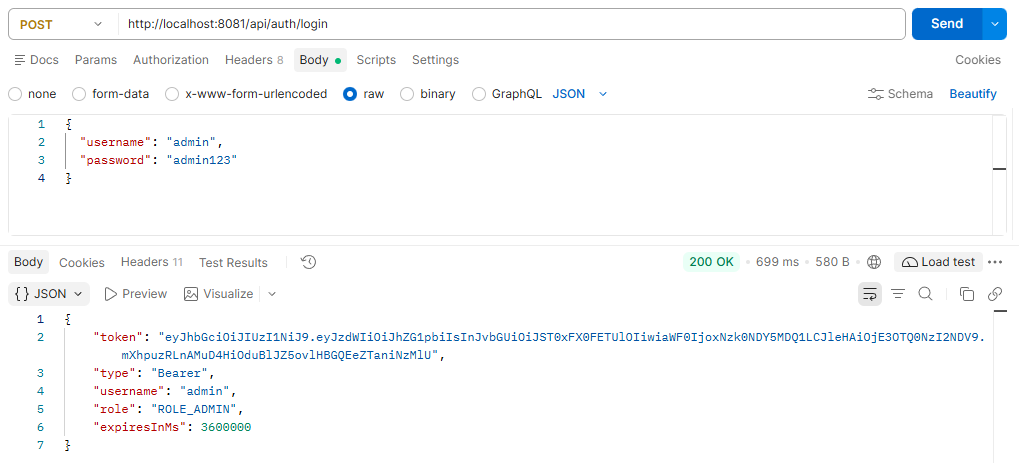
Spring Security is the standard Spring framework for authentication (who you are) and authorization (what you may do), and JWT (JSON Web Token) is a signed token that carries the user’s identity and role.It is used in microservices because a stateless JWT lets any service verify a caller without a server-side session, so it scales easily across many instances.The user logs in once, receives a token, and sends it as Authorization: Bearer <token> with every request. A filter validates the token and Spring Security enforces role rules.In this demo, a Secure Employee Management System lets everyone with a valid token read employees, while only ADMIN users can create, update or delete them.
Features
- User registration and login with BCrypt password hashing
- Stateless JWT authentication signed with HMAC-SHA256 and set to expire
- Custom JWT filter that validates the token on every request
- Role-based authorization (
ADMIN,USER) using@PreAuthorize - JSON
401 Unauthorizedand403 Forbiddenresponses - Public registration always creates a
USER, and an admin is seeded at startup - Users and employees stored in MySQL
Spring Security and JWT Types
| Kind | How it works | Used in this demo |
|---|---|---|
| HTTP Basic authentication | Username and password are sent with every request. | No |
| Session / form login | The server keeps a session and gives the browser a cookie. | No |
| JWT (stateless token) authentication | The client sends a signed token and the server keeps no session. | Yes |
| OAuth2 / OpenID Connect | A separate authorization server issues the tokens (Keycloak, Okta and similar). | No (the production choice for larger systems) |
| Authorization kind | Description | Used in this demo |
|---|---|---|
| URL-based rules | requestMatchers("/api/auth/**").permitAll() in the security filter chain |
Yes (public auth endpoints) |
| Method-level rules | @PreAuthorize("hasRole('ADMIN')") on controller methods |
Yes (employee endpoints) |
| JWT kind | Description | Used in this demo |
|---|---|---|
| Access token | Short-lived token sent with each request. | Yes (1 hour) |
| Refresh token | Long-lived token used only to get a new access token. | No |
| HS256 (shared secret) | Signed and verified with the same secret key. | Yes |
| RS256 (public/private key) | Signed with a private key and verified with a public key by other services. | No |
Hands-on Experiment: Building a Secure Employee Management System with Spring Security and JWT
Aim: To build a Spring Boot application that secures its REST APIs with Spring Security and JSON Web Tokens: users register and log in to get a signed token, and role-based rules decide which employee operations each user may perform.
Step-by-Step Application Development
Step 1: Generate the Project via Spring Initializr
Open https://start.spring.io and select:
- Project: Maven
- Language: Java
- Spring Boot: 3.3.x
- Group:
com.example - Artifact:
secure-employee-management - Packaging: Jar
- Java: 17
- Dependencies: Spring Web, Spring Security, Spring Data JPA, MySQL Driver
Click Generate, extract the zip and open it in your IDE. Then add the three JJWT dependencies (jjwt-api, jjwt-impl, jjwt-jackson, version 0.12.6) to pom.xml, as shown in the pom.xml above.
Step 2: Project Structure
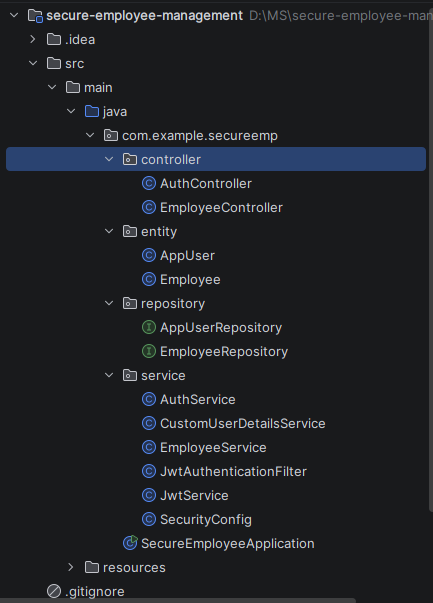
Step 3: Create files according to the project structure
package com.example.secureemp.entity;

import com.fasterxml.jackson.annotation.JsonProperty;
import jakarta.persistence.*;

@Entity
@Table(name = "app_users")
public class AppUser {

    @Id
    @GeneratedValue(strategy = GenerationType.IDENTITY)
    private Long id;

    @Column(unique = true, nullable = false)
    private String username;

    // Stored as a BCrypt hash. WRITE_ONLY: accepted in requests, never sent in responses.
    @JsonProperty(access = JsonProperty.Access.WRITE_ONLY)
    @Column(nullable = false)
    private String password;

    // ADMIN or USER
    private String role;

    public AppUser() {
    }

    public AppUser(String username, String password, String role) {
        this.username = username;
        this.password = password;
        this.role = role;
    }

    public Long getId() { return id; }
    public void setId(Long id) { this.id = id; }

    public String getUsername() { return username; }
    public void setUsername(String username) { this.username = username; }

    public String getPassword() { return password; }
    public void setPassword(String password) { this.password = password; }

    public String getRole() { return role; }
    public void setRole(String role) { this.role = role; }
}
package com.example.secureemp.entity;

import jakarta.persistence.*;

@Entity
@Table(name = "employees")
public class Employee {

    @Id
    @GeneratedValue(strategy = GenerationType.IDENTITY)
    private Long id;

    private String name;

    @Column(unique = true)
    private String email;

    private String department;
    private String designation;
    private Double salary;

    public Employee() {
    }

    public Long getId() { return id; }
    public void setId(Long id) { this.id = id; }

    public String getName() { return name; }
    public void setName(String name) { this.name = name; }

    public String getEmail() { return email; }
    public void setEmail(String email) { this.email = email; }

    public String getDepartment() { return department; }
    public void setDepartment(String department) { this.department = department; }

    public String getDesignation() { return designation; }
    public void setDesignation(String designation) { this.designation = designation; }

    public Double getSalary() { return salary; }
    public void setSalary(Double salary) { this.salary = salary; }
}
package com.example.secureemp.repository;

import com.example.secureemp.entity.AppUser;
import org.springframework.data.jpa.repository.JpaRepository;
import org.springframework.stereotype.Repository;

import java.util.Optional;

@Repository
public interface AppUserRepository extends JpaRepository<AppUser, Long> {

    Optional<AppUser> findByUsername(String username);

    boolean existsByUsername(String username);
}
package com.example.secureemp.repository;

import com.example.secureemp.entity.Employee;
import org.springframework.data.jpa.repository.JpaRepository;
import org.springframework.stereotype.Repository;

@Repository
public interface EmployeeRepository extends JpaRepository<Employee, Long> {

    boolean existsByEmail(String email);
}
package com.example.secureemp.service;

import com.example.secureemp.entity.AppUser;
import com.example.secureemp.repository.AppUserRepository;
import org.springframework.http.HttpStatus;
import org.springframework.security.authentication.AuthenticationManager;
import org.springframework.security.authentication.BadCredentialsException;
import org.springframework.security.authentication.UsernamePasswordAuthenticationToken;
import org.springframework.security.core.userdetails.UserDetails;
import org.springframework.security.crypto.password.PasswordEncoder;
import org.springframework.stereotype.Service;
import org.springframework.web.server.ResponseStatusException;

import java.util.LinkedHashMap;
import java.util.Map;

@Service
public class AuthService {

    private final AppUserRepository userRepository;
    private final PasswordEncoder passwordEncoder;
    private final AuthenticationManager authenticationManager;
    private final CustomUserDetailsService userDetailsService;
    private final JwtService jwtService;

    public AuthService(AppUserRepository userRepository,
                       PasswordEncoder passwordEncoder,
                       AuthenticationManager authenticationManager,
                       CustomUserDetailsService userDetailsService,
                       JwtService jwtService) {
        this.userRepository = userRepository;
        this.passwordEncoder = passwordEncoder;
        this.authenticationManager = authenticationManager;
        this.userDetailsService = userDetailsService;
        this.jwtService = jwtService;
    }

    // Public registration always creates a normal USER. ADMIN users are never self-registered.
    public Map<String, Object> register(AppUser request) {
        if (request.getUsername() == null || request.getUsername().isBlank()
                || request.getPassword() == null || request.getPassword().length() < 6) {
            throw new ResponseStatusException(HttpStatus.BAD_REQUEST, "Username required and password must be at least 6 characters");
        }
        if (userRepository.existsByUsername(request.getUsername())) {
            throw new ResponseStatusException(HttpStatus.CONFLICT, "Username already exists");
        }
        AppUser saved = userRepository.save(new AppUser(
                request.getUsername(),
                passwordEncoder.encode(request.getPassword()),
                "USER"));

        Map<String, Object> response = new LinkedHashMap<>();
        response.put("message", "User registered successfully");
        response.put("username", saved.getUsername());
        response.put("role", saved.getRole());
        return response;
    }

    public Map<String, Object> login(AppUser request) {
        try {
            // Checks the password against the BCrypt hash in MySQL
            authenticationManager.authenticate(
                    new UsernamePasswordAuthenticationToken(request.getUsername(), request.getPassword()));
        } catch (BadCredentialsException e) {
            throw new ResponseStatusException(HttpStatus.UNAUTHORIZED, "Invalid username or password");
        }

        UserDetails userDetails = userDetailsService.loadUserByUsername(request.getUsername());
        String token = jwtService.generateToken(userDetails);

        Map<String, Object> response = new LinkedHashMap<>();
        response.put("token", token);
        response.put("type", "Bearer");
        response.put("username", userDetails.getUsername());
        response.put("role", userDetails.getAuthorities().iterator().next().getAuthority());
        response.put("expiresInMs", jwtService.getExpirationMs());
        return response;
    }
}
package com.example.secureemp.service;

import com.example.secureemp.entity.AppUser;
import com.example.secureemp.repository.AppUserRepository;
import org.springframework.security.core.authority.SimpleGrantedAuthority;
import org.springframework.security.core.userdetails.User;
import org.springframework.security.core.userdetails.UserDetails;
import org.springframework.security.core.userdetails.UserDetailsService;
import org.springframework.security.core.userdetails.UsernameNotFoundException;
import org.springframework.stereotype.Service;

import java.util.List;

// Tells Spring Security how to load a user from MySQL
@Service
public class CustomUserDetailsService implements UserDetailsService {

    private final AppUserRepository userRepository;

    public CustomUserDetailsService(AppUserRepository userRepository) {
        this.userRepository = userRepository;
    }

    @Override
    public UserDetails loadUserByUsername(String username) throws UsernameNotFoundException {
        AppUser appUser = userRepository.findByUsername(username)
                .orElseThrow(() -> new UsernameNotFoundException("User not found: " + username));
        return new User(
                appUser.getUsername(),
                appUser.getPassword(),
                List.of(new SimpleGrantedAuthority("ROLE_" + appUser.getRole())));
    }
}
package com.example.secureemp.service;

import com.example.secureemp.entity.Employee;
import com.example.secureemp.repository.EmployeeRepository;
import org.springframework.http.HttpStatus;
import org.springframework.stereotype.Service;
import org.springframework.web.server.ResponseStatusException;

import java.util.List;

@Service
public class EmployeeService {

    private final EmployeeRepository employeeRepository;

    public EmployeeService(EmployeeRepository employeeRepository) {
        this.employeeRepository = employeeRepository;
    }

    public List<Employee> getAll() {
        return employeeRepository.findAll();
    }

    public Employee getById(Long id) {
        return employeeRepository.findById(id)
                .orElseThrow(() -> new ResponseStatusException(HttpStatus.NOT_FOUND, "Employee not found: " + id));
    }

    public Employee create(Employee employee) {
        if (employeeRepository.existsByEmail(employee.getEmail())) {
            throw new ResponseStatusException(HttpStatus.CONFLICT, "Employee email already exists");
        }
        employee.setId(null);
        return employeeRepository.save(employee);
    }

    public Employee update(Long id, Employee request) {
        Employee existing = getById(id);
        existing.setName(request.getName());
        existing.setEmail(request.getEmail());
        existing.setDepartment(request.getDepartment());
        existing.setDesignation(request.getDesignation());
        existing.setSalary(request.getSalary());
        return employeeRepository.save(existing);
    }

    public void delete(Long id) {
        getById(id);
        employeeRepository.deleteById(id);
    }
}
package com.example.secureemp.service;

import io.jsonwebtoken.JwtException;
import jakarta.servlet.FilterChain;
import jakarta.servlet.ServletException;
import jakarta.servlet.http.HttpServletRequest;
import jakarta.servlet.http.HttpServletResponse;
import org.slf4j.Logger;
import org.slf4j.LoggerFactory;
import org.springframework.security.authentication.UsernamePasswordAuthenticationToken;
import org.springframework.security.core.context.SecurityContextHolder;
import org.springframework.security.core.userdetails.UserDetails;
import org.springframework.security.core.userdetails.UsernameNotFoundException;
import org.springframework.security.web.authentication.WebAuthenticationDetailsSource;
import org.springframework.stereotype.Component;
import org.springframework.web.filter.OncePerRequestFilter;

import java.io.IOException;

// Runs on every request: reads "Authorization: Bearer <token>", validates it and
// puts the authenticated user into the SecurityContext.
@Component
public class JwtAuthenticationFilter extends OncePerRequestFilter {

    private static final Logger log = LoggerFactory.getLogger(JwtAuthenticationFilter.class);

    private final JwtService jwtService;
    private final CustomUserDetailsService userDetailsService;

    public JwtAuthenticationFilter(JwtService jwtService, CustomUserDetailsService userDetailsService) {
        this.jwtService = jwtService;
        this.userDetailsService = userDetailsService;
    }

    @Override
    protected void doFilterInternal(HttpServletRequest request,
                                    HttpServletResponse response,
                                    FilterChain filterChain) throws ServletException, IOException {

        String header = request.getHeader("Authorization");
        if (header == null || !header.startsWith("Bearer ")) {
            filterChain.doFilter(request, response);
            return;
        }

        try {
            String token = header.substring(7);
            String username = jwtService.extractUsername(token);

            if (username != null && SecurityContextHolder.getContext().getAuthentication() == null) {
                UserDetails userDetails = userDetailsService.loadUserByUsername(username);
                if (jwtService.isTokenValid(token, userDetails)) {
                    UsernamePasswordAuthenticationToken authentication = new UsernamePasswordAuthenticationToken(
                            userDetails, null, userDetails.getAuthorities());
                    authentication.setDetails(new WebAuthenticationDetailsSource().buildDetails(request));
                    SecurityContextHolder.getContext().setAuthentication(authentication);
                }
            }
        } catch (JwtException | IllegalArgumentException | UsernameNotFoundException e) {
            // Not authenticated: the request continues and is rejected with 401 later
            log.warn("Invalid JWT token: {}", e.getMessage());
        }

        filterChain.doFilter(request, response);
    }
}
package com.example.secureemp.service;

import io.jsonwebtoken.Claims;
import io.jsonwebtoken.Jwts;
import io.jsonwebtoken.io.Decoders;
import io.jsonwebtoken.security.Keys;
import org.springframework.beans.factory.annotation.Value;
import org.springframework.security.core.userdetails.UserDetails;
import org.springframework.stereotype.Service;

import javax.crypto.SecretKey;
import java.util.Date;

// Creates and validates JWT tokens
@Service
public class JwtService {

    @Value("${jwt.secret}")
    private String secret;

    @Value("${jwt.expiration-ms}")
    private long expirationMs;

    private SecretKey getSigningKey() {
        return Keys.hmacShaKeyFor(Decoders.BASE64.decode(secret));
    }

    public String generateToken(UserDetails userDetails) {
        String role = userDetails.getAuthorities().iterator().next().getAuthority();
        Date now = new Date();
        return Jwts.builder()
                .subject(userDetails.getUsername())
                .claim("role", role)
                .issuedAt(now)
                .expiration(new Date(now.getTime() + expirationMs))
                .signWith(getSigningKey())
                .compact();
    }

    public String extractUsername(String token) {
        return parseClaims(token).getSubject();
    }

    // Signature and expiry are verified while parsing; a bad token throws JwtException
    public boolean isTokenValid(String token, UserDetails userDetails) {
        Claims claims = parseClaims(token);
        return claims.getSubject().equals(userDetails.getUsername())
                && claims.getExpiration().after(new Date());
    }

    public long getExpirationMs() {
        return expirationMs;
    }

    private Claims parseClaims(String token) {
        return Jwts.parser()
                .verifyWith(getSigningKey())
                .build()
                .parseSignedClaims(token)
                .getPayload();
    }
}
package com.example.secureemp.service;

import org.springframework.context.annotation.Bean;
import org.springframework.context.annotation.Configuration;
import org.springframework.http.MediaType;
import org.springframework.security.authentication.AuthenticationManager;
import org.springframework.security.config.annotation.authentication.configuration.AuthenticationConfiguration;
import org.springframework.security.config.annotation.method.configuration.EnableMethodSecurity;
import org.springframework.security.config.annotation.web.builders.HttpSecurity;
import org.springframework.security.config.annotation.web.configuration.EnableWebSecurity;
import org.springframework.security.config.http.SessionCreationPolicy;
import org.springframework.security.crypto.bcrypt.BCryptPasswordEncoder;
import org.springframework.security.crypto.password.PasswordEncoder;
import org.springframework.security.web.SecurityFilterChain;
import org.springframework.security.web.authentication.UsernamePasswordAuthenticationFilter;

@Configuration
@EnableWebSecurity
@EnableMethodSecurity
public class SecurityConfig {

    private final JwtAuthenticationFilter jwtAuthenticationFilter;

    public SecurityConfig(JwtAuthenticationFilter jwtAuthenticationFilter) {
        this.jwtAuthenticationFilter = jwtAuthenticationFilter;
    }

    @Bean
    public SecurityFilterChain securityFilterChain(HttpSecurity http) throws Exception {
        http
            // CSRF protects cookie sessions; a stateless token API does not need it
            .csrf(csrf -> csrf.disable())
            .sessionManagement(session -> session.sessionCreationPolicy(SessionCreationPolicy.STATELESS))
            .authorizeHttpRequests(auth -> auth
                .requestMatchers("/api/auth/**").permitAll()
                .anyRequest().authenticated())
            .exceptionHandling(ex -> ex
                // No / invalid token -> 401
                .authenticationEntryPoint((request, response, authException) -> {
                    response.setStatus(401);
                    response.setContentType(MediaType.APPLICATION_JSON_VALUE);
                    response.getWriter().write("{\"status\":401,\"error\":\"Unauthorized\",\"message\":\"Valid JWT token required\"}");
                })
                // Logged in but wrong role -> 403
                .accessDeniedHandler((request, response, accessDeniedException) -> {
                    response.setStatus(403);
                    response.setContentType(MediaType.APPLICATION_JSON_VALUE);
                    response.getWriter().write("{\"status\":403,\"error\":\"Forbidden\",\"message\":\"You do not have permission for this action\"}");
                }))
            .addFilterBefore(jwtAuthenticationFilter, UsernamePasswordAuthenticationFilter.class);
        return http.build();
    }

    @Bean
    public PasswordEncoder passwordEncoder() {
        return new BCryptPasswordEncoder();
    }

    @Bean
    public AuthenticationManager authenticationManager(AuthenticationConfiguration configuration) throws Exception {
        return configuration.getAuthenticationManager();
    }
}
package com.example.secureemp.controller;

import com.example.secureemp.entity.AppUser;
import com.example.secureemp.service.AuthService;
import org.springframework.http.HttpStatus;
import org.springframework.http.ResponseEntity;
import org.springframework.web.bind.annotation.*;

import java.util.Map;

// Public endpoints (no token needed)
@RestController
@RequestMapping("/api/auth")
public class AuthController {

    private final AuthService authService;

    public AuthController(AuthService authService) {
        this.authService = authService;
    }

    @PostMapping("/register")
    public ResponseEntity<Map<String, Object>> register(@RequestBody AppUser request) {
        return ResponseEntity.status(HttpStatus.CREATED).body(authService.register(request));
    }

    @PostMapping("/login")
    public Map<String, Object> login(@RequestBody AppUser request) {
        return authService.login(request);
    }
}
package com.example.secureemp.controller;

import com.example.secureemp.entity.Employee;
import com.example.secureemp.service.EmployeeService;
import org.springframework.http.HttpStatus;
import org.springframework.http.ResponseEntity;
import org.springframework.security.access.prepost.PreAuthorize;
import org.springframework.web.bind.annotation.*;

import java.util.List;

// Protected endpoints: a valid JWT is required, and the role decides what is allowed
@RestController
@RequestMapping("/api/employees")
public class EmployeeController {

    private final EmployeeService employeeService;

    public EmployeeController(EmployeeService employeeService) {
        this.employeeService = employeeService;
    }

    @GetMapping
    @PreAuthorize("hasAnyRole('ADMIN','USER')")
    public List<Employee> getAll() {
        return employeeService.getAll();
    }

    @GetMapping("/{id}")
    @PreAuthorize("hasAnyRole('ADMIN','USER')")
    public Employee getById(@PathVariable Long id) {
        return employeeService.getById(id);
    }

    @PostMapping
    @PreAuthorize("hasRole('ADMIN')")
    public ResponseEntity<Employee> create(@RequestBody Employee employee) {
        return ResponseEntity.status(HttpStatus.CREATED).body(employeeService.create(employee));
    }

    @PutMapping("/{id}")
    @PreAuthorize("hasRole('ADMIN')")
    public Employee update(@PathVariable Long id, @RequestBody Employee employee) {
        return employeeService.update(id, employee);
    }

    @DeleteMapping("/{id}")
    @PreAuthorize("hasRole('ADMIN')")
    public ResponseEntity<String> delete(@PathVariable Long id) {
        employeeService.delete(id);
        return ResponseEntity.ok("Employee " + id + " deleted");
    }
}
package com.example.secureemp;

import com.example.secureemp.entity.AppUser;
import com.example.secureemp.repository.AppUserRepository;
import org.springframework.boot.CommandLineRunner;
import org.springframework.boot.SpringApplication;
import org.springframework.boot.autoconfigure.SpringBootApplication;
import org.springframework.context.annotation.Bean;
import org.springframework.security.crypto.password.PasswordEncoder;

@SpringBootApplication
public class SecureEmployeeApplication {

    public static void main(String[] args) {
        SpringApplication.run(SecureEmployeeApplication.class, args);
    }

    // Creates one ADMIN and one USER at startup (passwords are stored BCrypt-hashed)
    @Bean
    public CommandLineRunner initUsers(AppUserRepository userRepository, PasswordEncoder passwordEncoder) {
        return args -> {
            if (!userRepository.existsByUsername("admin")) {
                userRepository.save(new AppUser("admin", passwordEncoder.encode("admin123"), "ADMIN"));
            }
            if (!userRepository.existsByUsername("user")) {
                userRepository.save(new AppUser("user", passwordEncoder.encode("user123"), "USER"));
            }
        };
    }
}
spring.application.name=secure-employee-management
server.port=8081
# ---------- MySQL ----------
spring.datasource.url=jdbc:mysql://localhost:3306/secure_employee_db?createDatabaseIfNotExist=true&useSSL=false&serverTimezone=UTC
spring.datasource.username=root
spring.datasource.password=password
spring.jpa.hibernate.ddl-auto=update
spring.jpa.show-sql=true
# ---------- JWT ----------
# Base64 encoded 256-bit secret (change it for every real deployment)
jwt.secret=ANrR8AQ+ib5EU0nu6a2UQYHsgstKkSgc+rWIm+x4mqo=
# Token validity: 1 hour
jwt.expiration-ms=3600000Code language: PHP (php)Step 4: Run the Application