
JDBC (Java Database Connectivity) is a standard Java API used to connect Java applications with relational databases. It provides a common set of interfaces and classes for executing SQL queries and processing database results. JDBC architecture consists of components such as the JDBC API, DriverManager, JDBC Driver, Connection, Statement, ResultSet, and Database.
Architecture
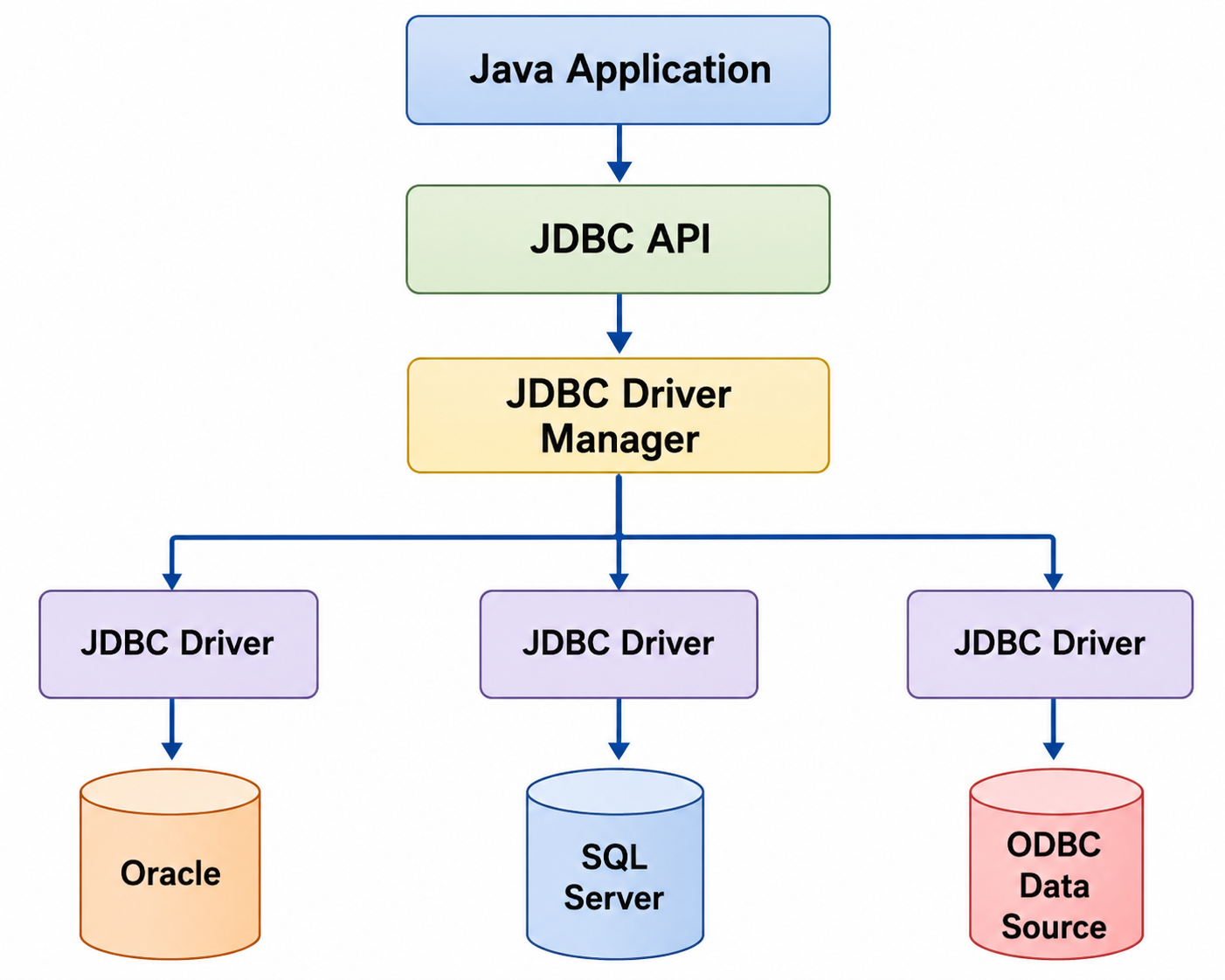
Explanation of Components
| Component | Explanation |
|---|---|
| Java Application | The Java program that uses JDBC to perform database operations such as inserting, updating, deleting, and retrieving data. |
| JDBC API | Provides standard interfaces and classes such as Connection, Statement, PreparedStatement, and ResultSet for database connectivity. |
| DriverManager | Manages JDBC drivers and establishes a connection between the Java application and the database. |
| Connection | Represents an active connection or session between the Java application and the database. |
| Statement | Used to execute simple SQL statements against the database. |
| PreparedStatement | Used to execute parameterized and precompiled SQL statements. |
| ResultSet | Stores the data returned by a SELECT SQL query and allows the application to read the results. |
| DatabaseMetaData | Provides information about the database, such as database name, tables, columns, and supported features. |
| JDBC Driver | Database-specific software that converts JDBC calls from the Java application into commands understood by the particular database. |
| Database | The actual relational database where data is stored, retrieved, updated, and deleted. |